"So... How do I lose belly fat?" 😕
If you've done endless crunches, cut rice, joined a 6-week challenge, or bought fat burners — and the belly is still there — you're not the problem.
The information you've been given is.
This guide will walk you through what's actually happening in your body, what the science says works, and exactly what to do first.
Scroll down to continue ↓
First, we need to understand how fat loss actually works.
Your body has a daily calorie budget.
Your body burns a certain number of calories just to exist.
Add in everything you move throughout the day — that becomes your total daily burn, your maintenance level.
Think of your body like a bank account.
Your deposits
- • Everything you eat
- • Everything you drink (including alcohol)
- • Liquid calories — juice, soda, coffee drinks
Your withdrawals
- • Basal metabolic rate (just staying alive)
- • Daily movement & activity
- • Exercise & workouts
- • Digesting food (yes, really)
Calories in = deposits.
Calories out = withdrawals.
Deposit more than you spend → fat goes up.
Spend more than you deposit → fat goes down.
It's not what you eat — it's 100% your calorie balance.
You can lose fat eating McDonald's and rice
If your total calories are below what you burn, you will lose fat — regardless of what those calories came from.
You can gain fat eating salad
If your total calories are above what you burn, you will gain fat — even if every meal was "clean."
Well, almost.
A calorie deficit will absolutely burn fat, but you cannot tell your body where to burn it from.
You don't get to point at your belly and say "start here." Your body decides the order based on your genetics and hormones.
The belly WILL get smaller — it just won't necessarily be the first one to go.
You can't choose where the water drains from.
Scroll to drain the glass ↓
The goal isn't to "target" your belly.
The goal is to create the conditions for your body to burn fat from everywhere.
Alright, now that we understand that — let's figure out exactly what you should do.
When trying to lose fat, their first instinct is to exercise more.
Hit the gym. Do crunches. Go for a run.
It makes sense — you feel like you're doing something towards your fitness goals, right?
But here's the problem...
Exercise alone won't get you there.
Scroll to burn it off ↓
The Lesson Is Simple
You don't have to do cardio if you don't want to.
You can't outrun your fork.
Exercise is not an efficient way to create a calorie deficit. One bottle of soda takes 45 minutes of running to undo. The math will never be in your favor.
For fat loss, what you eat will always matter more than how much you exercise.
But that doesn't mean movement is useless.
While exercise burns fewer calories than you think and takes serious effort to move the needle, it's still a tool worth using.
The easiest way to use movement to your advantage is to simply just walk more.
Person A
30-min run, sits the rest of the day
Person B
0 steps throughout the day.
Walk more. Sit less. That's the lever.
There's nothing wrong with cardio — go for a run if you actually enjoy it.
But if not? Feel free to aim for 8,000 to 10,000 steps a day. Walk places, take the stairs, pace on calls.
This is called NEAT
Non-Exercise Activity Thermogenesis — slow, low-effort movement that burns more calories than most people think.
But really, the best way to lose fat is to control your eating.
Exercise burns calories, but not much. Daily movement helps as well, but it has limits.
The single biggest thing you can do to create a calorie deficit is eat less.
Not starve yourself. Not cut everything you love. Just eat a little less than your body burns — consistently.
To do that, you need a strategy — not just willpower.
That's exactly what a diet does. It's a way of eating and a set of rules that naturally guides you to consume fewer calories.
So what's the best diet?
Here's the secret: they all work.[1]
Fasting
Low Carb
Eating
[1] International Society of Sports Nutrition position stand: diets and body composition
So pick a diet that you can actually stick with.
A "perfect" diet you hate and quit in two weeks is worth nothing.
Detox teas, juice cleanses. Miserable to stick to — and no real deficit happening anyway.
Eating whatever you want, whenever you want. Fun, but no deficit happening and possibly even gaining fat.
Giving up all carbs, 1,000-cal crash diets. Works short-term, but you'll quit and think the problem was you.
You're in a deficit AND you actually like eating this way. This is what we're building toward.
Calorie counting (the RIGHT way)
Think of it as a spending budget. You get a set number of calories to "spend" each day — and how you spend them is entirely up to you.
₱12,000
1,700 cal
Get your number
Use our TDEE calculator to find out your ideal calorie targets — it takes about a minute.
Calculate my TDEEThe calculator will open in a new tab. Come back here when you're done.
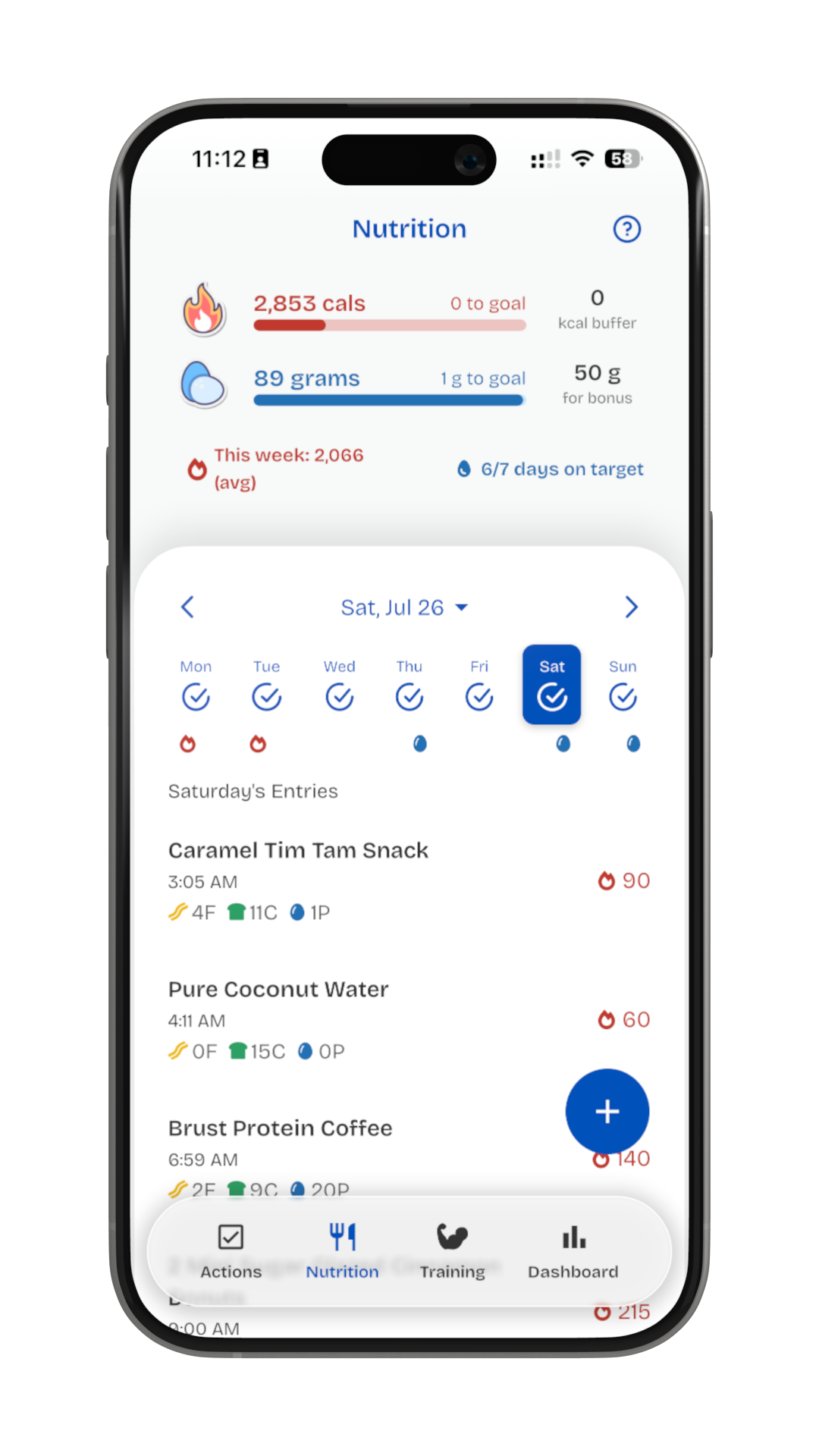
Download a food tracker
Use a tracker that makes it easy and frictionless to log what you eat. We suggest using Finally Fit.
Another option: Cronometer
Log everything you eat.
Before you start optimizing, first establish the habit of tracking what you eat. Don't change anything yet — just log it.
Don't forget the hidden ingredients — the oil your food was cooked in, the sauce on the side, the rice at the bottom of the bowl. Those calories add up fast.
Analyze your logs and ask yourself these questions:
🧮 What was my average daily total?
Add up the three days and divide by three. That's your baseline. Compare it to your TDEE target — the difference is the gap you need to close.
🔍 Where did most of it come from?
It's rarely the rice or the ulam. Look at drinks, sauces, cooking oil, and snacks. Those are almost always where the hidden calories are.
✂️ What changes can I make?
We cover the three strategies for closing your calorie gap on the next slide.
No, you don't need to stop eating your favorite food.
Most people are only 300–500 calories over. That's one or two things in your day. There are three ways to close that gap:
🚫 Eliminate
Cut it out entirely
Starbucks Frappe
~300 calories
Starbucks Frappe
~300 cal gone
🔄 Substitute
Swap for something lower
Regular Coke
~140 cal each
Coke Zero
~0 cal each
📉 Reduce
Eat less of it
1.5 cups of rice
per meal
1 cup of rice
~100 cal saved
Your strategy should change based on which type of person you are.
You can have a few bites and stop.
Eat anything, just stay within your budget. No foods are off-limits. Total flexibility is your advantage — use it.
Once you start, stopping is hard.
Keep your budget, but also remove your trigger foods from the house. It's much easier to say no when it's not an option to eat in the first place.
All calories count equally for fat loss.
But not for hunger.
Technically, 500 calories of Jollibee and 500 calories of grilled chicken + rice + veggies are identical for fat loss. A calorie is a calorie.
But they are not equal for how full you'll feel — and being full is what makes a deficit sustainable long-term.
That's why most of your calories should come from food that keeps you full.
You don't have to quit eating anything. You just have to eat less of the things that are costing you the most calories.
- ✓Carbs with fiber (rice, oats, sweet potato)
- ✓Lean protein (eggs, chicken, fish, pork)
- ✓Vegetables (whatever you actually eat)
- ✓Fruit (banana, mango, apple)
- ✓Water, black coffee, unsweetened drinks
- •Fast food (Jollibee, McDo, etc.)
- •Sweetened drinks (milk tea, fruit juices, 3-in-1 coffee)
- •Packaged snacks (chips, crackers, cookies)
- •Heavy fried food (fried chicken skin, crispy pata)
A few smarter choices add up to big changes.
~2,450 cal
Garlic rice + egg + bacon
→ ~450 cal
Tonkatsu set at a Japanese restaurant
→ ~850 cal
Frappuccino + croissant
→ ~600 cal
Rice + pork + veggies
1.5 cups rice → ~550 cal
Same foods you'd normally eat.
~1,700 cal
Garlic rice + egg + Spam Lite
Replaced → ~400 cal
Chicken teriyaki, less rice
Reduced → ~600 cal
Caramel macchiato
Replaced + eliminated → ~250 cal
Rice + pork + veggies
Reduced to 1 cup → ~450 cal
In a calorie deficit. Losing fat.
How fast can you lose fat?
Most people expect dramatic results in weeks, but the human body doesn't work that way.
Real, lasting fat loss is slow by nature — and that's actually a good thing. Slow loss means you're burning fat, not muscle or just water weight.
Aim for a safe, sustainable rate.
of body weight per week
Safe, sustainable fat loss rate
per week at 80kg
What a good deficit produces
for visible changes
But they will come
Keep in mind that your weight won't drop in a straight line.
Daily fluctuations are normal — caused by water retention, sodium, stress, and hormones. What matters is the trend over weeks, not any single weigh-in.
The blue line is what matters. The gray is just noise.
If you gained weight overnight, don't panic. That's normal.
- →Sodium-heavy meal the night before → water retention → scale goes up 1kg. Not fat.
- →Didn't drink enough water → scale looks lower. Not real fat loss yet.
- →Time of the month, stress, sleep — all affect the scale daily.
The rule: ignore single weigh-ins.
Weigh yourself at the same time each morning, and look at the trend over 3–4 weeks. That's the real signal.
You have everything you need to start.
You can't spot reduce belly fat
Fat loss happens everywhere at once. The belly will follow when you lose fat overall.
A calorie deficit is the only mechanism for fat loss
Eat less than your body burns. That's the whole equation.
You can't outexercise a bad diet — but movement still helps
What you eat matters more than how much you exercise, but more movement will make the deficit easier.
There's no magic diet — they all create a deficit
Pick the one you can actually stick with long-term.
Calorie counting is flexible, not restrictive
You can eat any food — you just understand what it costs and plan around it.
Ready to start tracking?
Finally Fit has everything you need to track your calories, log your food, and build the consistency that actually gets results.
iOS · Free to download